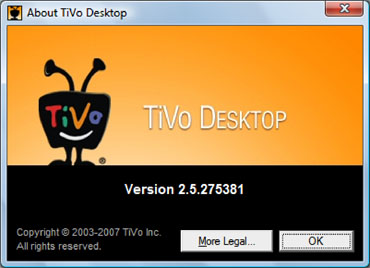
TiVo’s PR agency just confirmed to me that Desktop 2.5 is launching today. And while the web page hasn’t been updated yet, the download link has been discovered. New features, as reported Monday, can be seen in my installation window:
TiVo’s PR agency just confirmed to me that Desktop 2.5 is launching today. And while the web page hasn’t been updated yet, the download link has been discovered. New features, as reported Monday, can be seen in my installation window:
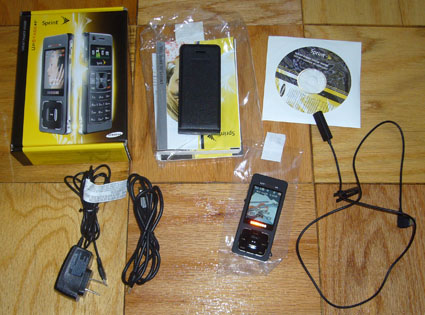
As promised, here’s your chance to win the schizophrenic multi-talented Samsung UpStage for use on the Sprint network. And if you end up feeling like I do about this phone… well, these things are moving for over $150 on ebay.
On the last two giveaways (Tendon, Monster) I had the distinct impression that some non-regulars stumbled in looking for freebies. Perhaps they compulsively search Technorati for blog contests? Who knows. While I obviously appreciate new folks checking out the site, I prefer to save the goodies for those who’ve invested a bit more in the success of ZNF. So…
Leave one comment saying you want in on the giveaway. The catch is that you must provide a link to a previous comment you’ve left here, other than prior contests. (The comment date stamp is your permalink.) And if you’ve never left a comment, now you’ll have some incentive going forward. Let’s see how this experiment works out…

I don’t read much in hard copy anymore, but I did leaf through the print version of PC World while on the beach last weekend. One article caught my attention as much for what it didn’t say as for what it did report. The piece, Early IPTV Uses Only a Little of Its Fat Pipe, missed a few critical points. And having made my own share of mistakes and errors of omission in the blogging business, I thought I’d make some amends by adding in information where I do have a little knowledge.
First, the IPTV story profiles AT&T and Verizon, but it does so without making the distinction that AT&T delivers all-IP TV, while Verizon uses RF with an IP return path. Essentially Verizon has chosen to use IP only for certain interactive services, and actually more closely emulates a cable network architecture than AT&T’s offering.
Dave’s “Walking Desk” (aka Treadmill+Laptop). Inspired by Matt’s Elliptical Slinging and Jason’s FatBlogging.
A periodic roundup of relevant news… Netflix Watch Now Movie Archive Hack: Brent Evans Third Generation HD DVD Players Get Official: Engadget Watch Out For Wireless High-Def TV: CNET OpenMoko Neo Dev Kit Unboxing: Gizmodo Billboard Hot 100 Chart To Include Online Streaming: paidContent
Guess Dell isn’t done making portable multimedia devices after all, and has announced plans to acquire Zing: In a move that reflects the renewed interest and energy being directed at its Consumer business, Dell plans to use ZING and its capabilities to continue improving the entertainment experiences it provides its customers. What makes this doubly … Read more
As early as tomorrow, TiVo will grace us with Desktop 2.5 (PC) featuring: Support for Windows Vista. Support for DivX and Xvid formats for Web Video Conversions (wrapped in .avi or .divx containers). Convert individual shows from Desktop’s Now Playing list at any time, to any profile, by right-clicking. Web video conversions? Hm! Can we … Read more
Knowing my love for Pandora, Dave sent me a link to Slacker a couple weeks back with a little nudge suggesting I try it out. The service has been getting ridiculously positive press reviews, and apparently the company will be launching its own hardware devices in the near future.
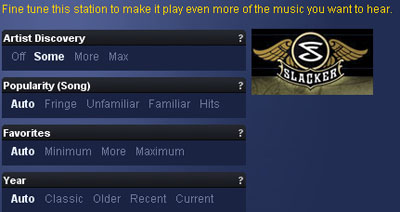
So how does Slacker stack up? The Web application is fabulous. It is extremely easy to set up customized radio stations based on any range of musical artists. Any artist in your list also brings up recommendations for other artists in the same genre that you can choose to add to your station. Then there’s a nifty little function called fine tuning. Fine tuning lets you decide the levels of music discovery you want to include in your channel, as well as how popular the songs should be, how often your personal favorites should be included, and what musical eras can be referenced. It sounds complicated, but in reality the fine tuning function is simple, fast and very powerful.
I’ve had some issues with Slacker crashing on me, but not enough to deter me from using the beta application. My bigger issue is that right now, I’m addicted to the Squeezebox and being able to access customized radio without my PC. We’ll have to see what happens when the Slacker hardware comes out later in the year. Whether I think it’s worth converting to Slacker will probably depend on two things: