Motorola Atrix Smartphone/Netbook Combo Is HOT

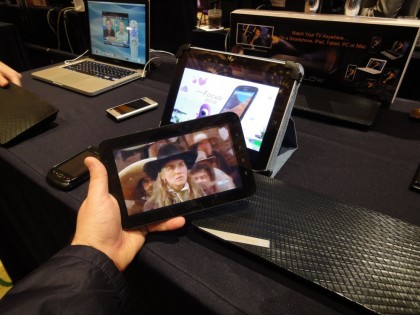
Not only is Motorola’s Atrix one of the hottest smartphones at the show, it’s quite possibly the hottest gadget overall. It’s a sleek Android handset powered by a dual core processor that feels a whole lot more solid than say Samsung’s Galaxy S line. But with so many nicely specced Android devices coming to market, … Read more

Chumby Rolls Its Own 8″ Widget Station

After seeing Sony and Best Buy harness the power of their widget platform, Chumby is following suit with their own dedicated kitchen companion. And given its styling, that’s where you’ll want it — versus the Sony Dash which is equally at home in the bedroom as a super-powered Internet-connected alarm clock. The upcoming “personalized Internet … Read more

Watch Slingbox on Google TV!

slingplayer-googletv-3

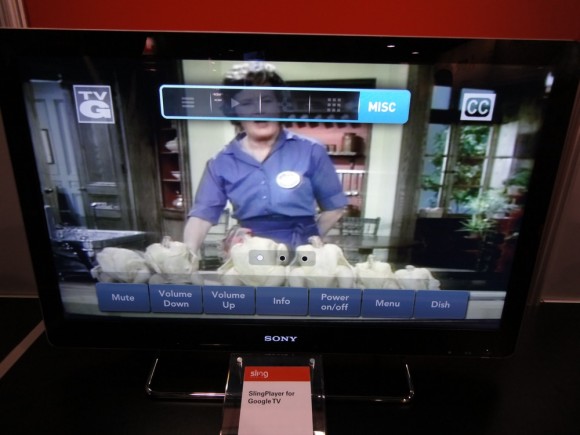
It turns out my old friends at Sling Media do have one or two new and notable items to share from CES. And first up is a Google TV SlingPlayer client — eliminating the need for dedicated SlingCatcher hardware (that didn’t turn out so great anyway). It should go without saying that I’m very pleased to see Sling move in this direction… as I assume this is just the first of various television- and set-top-based apps.

The initial Google TV app isn’t actually an app, but rather a Flash website optimized for the platform. As you can see from the pics, they’re logically carrying the Android interface onto the Android-based Google TV. The software and experience look pretty dang complete, with streaming up to 1080i, but all Sling will tell me is that they intend to launch sometime this year. However, it’d make sense to see them ultimate move to a dedicated app if/when Google launches a television-based marketplace – something that seems like an inevitability.

Read more

Intel Doubles Down on WiDi

Intel’s doubled down on their Wireless Display technology, aka WiDi. And while last year they had a single partner in Netgear, v2 will be offered by a variety of hardware manufacturers including Toshiba and D-Link. The WiDi premise is simple: stream anything/everything from your computer display to a television. Of course, this isn’t a new … Read more

What If Verizon FiOS TV Was an App?

Verizon FiOS TV CES 2011 3

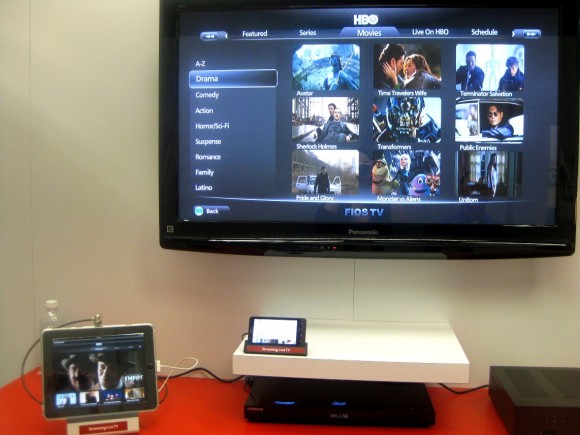
When Verizon launched FiOS TV, it launched it as a hybrid QAM/IP service – using QAM for broadcast television, and IP for VOD services and widgets. That’s about to change. Quietly, and very much behind the scenes, Verizon has been running an overhaul of its infrastructure in order to be able to deliver everything over IP. This is not IP as in the free-and-clear Internet, but IP as in a managed IP network used to deliver both multicast and interactive content.

In a meeting with Verizon exec Joe Ambeault here at CES, I learned that the company is very much committed to moving everything to its new IP platform. Consumers watching traditional FiOS TV should never see a difference, but by transitioning to IP, Verizon will have an opportunity to deliver its television service to a wide range of web-connected gadgets in the form of an app. In other words, FiOS TV will become just another service you buy in an app store – accessible across multiple screens and delivery platforms. In theory, consumers could even bring their own broadband to the table (FiOS or otherwise) and just layer FiOS TV on top.

The implications for this paradigm shift are a bit overwhelming, but in the short term, we can think of it just as a way to get access to content on more devices. If FiOS TV is an app, there’s no reason subscribers can’t access their shows from a tablet, smartphone, or laptop. The content doesn’t get delivered as part of a parallel TV-Everywhere system, but as a single IP solution that goes across every screen that consumers might want to use. We’ve seen hints of this in the new FlexView brand, but the model goes much further than anything we’ve seen deployed yet. As far as Verizon is concerned, the technical challenges have pretty much been solved. Again, in theory, consumers who don’t have access to FiOS Internet could get the television service added on to an existing non-Verizon ISP contract. That won’t happen any time soon, but the reasons are purely commercial, not technological. And the commercial situation is changing all the time.

Read more
Catching Up With Boxee (iPad, Iomega)

I spent a few minutes catching up with Boxee CEO Avner Ronen this evening. First off, the upcoming Iomega Boxee Box looks much better in person than it does in their press shot – for a rectangular black plastic box, it’s pretty sharp. It’s also larger than I had envisioned. The QWERTY remote seems practical. I … Read more

Two New Vulkano Placeshifters On Tap

Unfortunately, Monsoon Multimedia’s Vulkano wasn’t greeted with the warmest reception upon launch last fall. I was fired up with the Vulkano’s promise when I was briefed pre-release at CES 2010, yet the reality didn’t live up to my possibly unreasonable expectations. I’d christened it a “Godbox” given it’s myriad capabilities – time shifting, placeshifting, local media playback, and Internet-sourced content. But, as we know, good ideas aren’t enough.

But Monsoon’s been listening to the feedback and continuing to broker deals. The firmware has seen improvement and the that work is ongoing. In fact, the Vulkano setup experience continues to be optimized (or is that humanized) and it sounds like streaming, versus copying, of DVR-ed content is under development. YouTube’s pretty lonely as the sole Internet app, yet I hear Monsoon is having discussions with several video providers (the usual suspects) and a selection of Yahoo TV widgets may make an appearance this spring.

Read more

MultiTouch Has a Smarter Big Screen

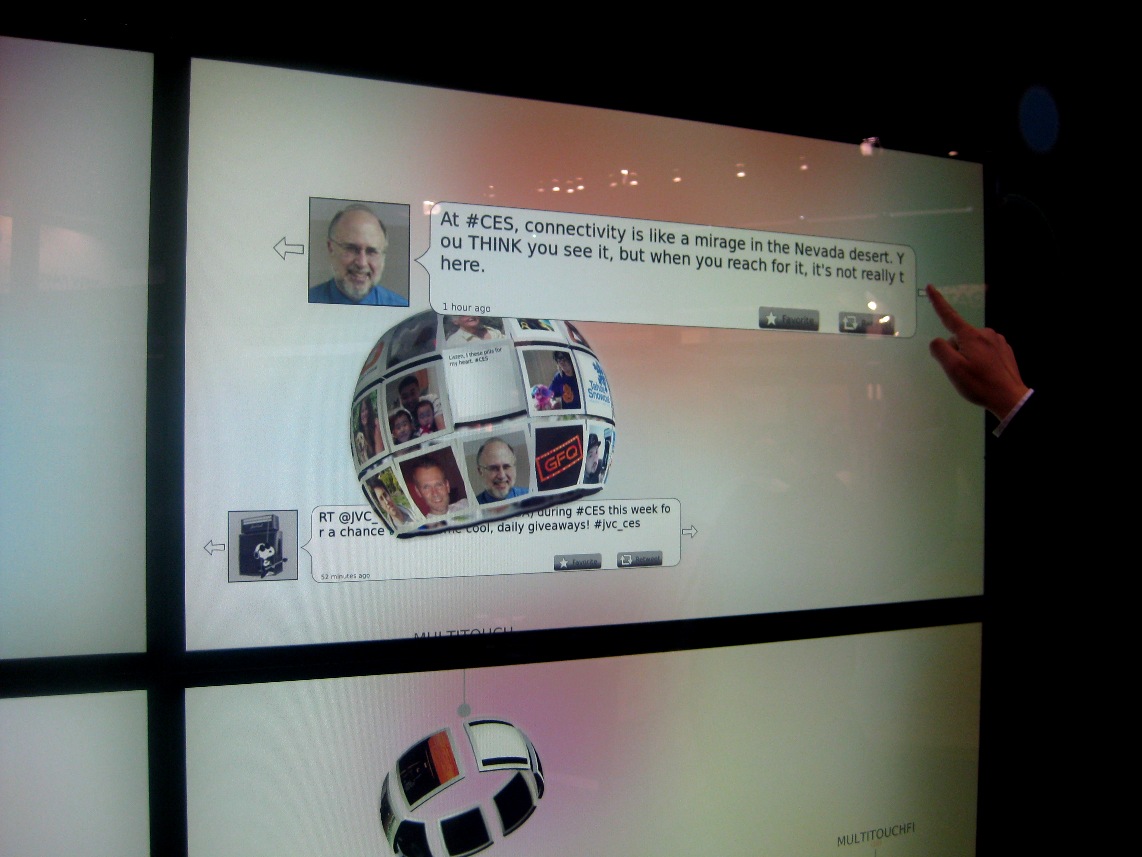
Smart TVs are making a lot of the headlines this week, but a company called MultiTouch has a different genre of screens on display, and they are wicked cool. The MultiTouch Displays are similar to the Microsoft Surface technology that was all the rage a few years back, and to the HP TouchSmart product that Dave got a chance to play with at CES 2009. However, the displays from MultiTouch are modular, meaning you can connect multiple screens together; they’ve been implemented all over the world in tables and walls; and the platform is open so developers can create their own applications for the touchscreen interface. And oh, what a touchscreen interface it is.

The applications on display in the MultiTouch booth include a Twitter wall, a photo table, and a table application that was created for Dom Perignon with interactive champagne bubbles, a customized menu, and even table games. The company says it also has the technology deployed in medical, military, museum, and university environments, among others. The screens support an unlimited number of touch points from fingertips, to 2D markers, to household objects like coins. And because the platform is open, the possible applications are virtually limitless.

At CES, MultiTouch has announced the next-gen version of its platform and dubbed the technology MultiTaction.  The resulting displays are thinner, and scalable for screens ranging from “32 to 100 inches and beyond.” The company also says it will be ready to ship for the consumer market no later than Q3 of this year. The displays aren’t cheap, but at $4,000 a pop, they’re not out of reach for a certain slice of the population. And that’s the price this year. Surely eventually mass production will drive the price down further.

Read more