Hulu Drops The Hammer

I sort of figured this day would come… Based on my perception of the licensing/royalty complexities and content providers fear that a current web video catalog piped to the television competes with live broadcasts. Hulu has shown their true colors – spawned of big media and beholden to big media. And Boxee has become a … Read more

Digital Media Bytes

A periodic roundup of relevant news… from our other blogs: LTE on the Streets of Barcelona Parts of of Barcelona that are decked out in an LTE network which Motorola deployed the network over the last two weeks specifically for mobile broadband demonstrations throughout the Mobile World Conference. Hauppauge & MSFT Bringing Windows 7 HD-PVR … Read more

March Madness Online going HD w/ Silverlight

Mari and I have been talking up the CBSSports.com NCAA March Madness on Demand for what seems like years. While we’ve had occasional issues getting access due to overwhelming site traffic, the service has largely been great a success. Especially during for folks stuck in an office and without a Slingbox during those first few … Read more

The Free Media-centric iPhone Apps of the Week

i.TV The i.TV entertainment listings app isn’t new, but the 1.3 update offers a new and visually appealing landscape grid guide (above) with pop-up show info “cards.” Previous functionality, such as TiVo scheduling and Netflix queue management, remains. And is joined by performance and stability improvements. Roxio Streamer Roxio Streamer is a brand new app … Read more

Choosing a Broadband Card (Verizon or Sprint)

For the better off of ten years, I’ve been a fairly frequent business and pleasure traveler. And staying connected has always been a top priority. Back in the old days, our options were quite limited – usually involving dialup access of some sort. I distinctly recall using a Palm V and modem to quickly check email, without firing up a laptop, while on the road in 1999 or 2000. The situation is much better these days, with numerous and exponentially faster wireless options.

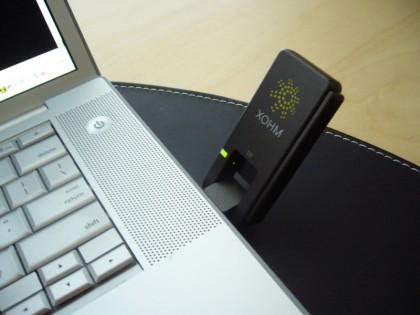
Although both can be great options, for the purpose of this post, we’ll set aside mobile phone tethering and pervasive WiFi services to focus on dedicated data cards. If your (or your employer’s) budget permits, broadband cards (or integrated services) generally provide the quickest and most secure way to hit the Internet from a laptop and run about $60/month. The last few years, I’ve utilized several 3G cards from Verizon, Sprint, and AT&T (plus a 4G Xohm card, pictured above) all over the country.

In choosing a broadband card and service, most modern 3G hardware should be fine. Assuming you can get a good deal (which you usually can), the key factors in making a decision are access, coverage, and contract terms. Of course, if your employer is providing the card, this could be out of your hands. But notice I said 3G. That should immediately rule out T-Mobile with their fledgling 3G network and Clear/Xohm+Sprint with their slowly expanding 4G WiMax network – the footprint is small, and only suitable for folks who rarely need to access data services outside their home area. So that leaves AT&T, Verizon, and Sprint (3G).
Read more

AMC’s Best Picture Showcase

2008 was the rare year in which I missed every Oscar Best Picture nominee. Pretty depressing for a (former?) film buff. Fortunately, AMC’s hooked me up with a ticket to their all-day Best Picture Showcase being held Saturday (2/21). I may have neglected to mention to their rep that I’d planned to attend anyhow – … Read more

Digital Media Bytes: Last100 Edition

A periodic roundup of relevant news… from our friends at Last100: Spotify, a very compelling music streaming service My music streaming weapon of choice used to be Pandora until it stopped being accessible from the UK a while back. Enter Spotify, a new music streaming service, which this week publicly launched in the UK. Since … Read more

The iTunes Consolidation Project

On the day Apple implemented single track iTunes Plus upgrades, I decided to take our entire library DRM-free. In fact, frustration with Apple’s (prior) DRM-encumbered system pushed us onto Amazon MP3s. However, while most of our music has been ripped from CD, we have made a number of iTunes purchases over the years. I’m unaware of exactly how much Apple music we own or what the per-track upgrade cost is. In the end, it didn’t even matter. Freedom is priceless.

The first task on my computer was to locate the upgrade option in the cluttered iTunes Store interface, which I found linked in a right-hand sidebar. From there, converting my davezatz@mac purchases tracks was a breeze. Unfortunately, I’ve also made purchases under a davezatz@yahoo account – which led to unforeseen frustration. For example, while I could license iTunes to play music from both logins on a computer, my iPhone will only take one. And I never did discover how to merge two accounts. So I logged out of davezatz@mac and attempted to log into davezatz@yahoo, to unlock those tracks, only to discover the account or password had been disabled. While searching the iTunes Support site for a way to gain access to this second account, I was pleasantly surprised to discover Apple offers live chat. The rep I ended up with was exceptional – she quickly reset my password and walked me through upgrading the remainder of my iTunes. The last step was unlocking Melissa’s iTunes, via her computer and account, which was painless.

In the end, we spent around $45 and the process actually took less time than it will to write this post. The next step is centralizing our music library. I’m thinking of consolidating the collection onto the networked 750GB Maxtor OneTouch 4 hanging off our Airport Extreme Base Station (AEBS). I believe this would provide access to all tracks from every computer in the home while also enabling us to create our own custom playlists (that I can sync to my iPhone and she can sync to her iPod Nano fatty). Has anyone gone down this path – am I on target?

Read more