FCC Says Price of “Expanded Basic” TV up 5.4%

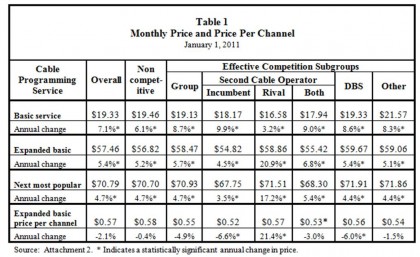
The FCC yesterday released its latest pricing data on pay-TV services. In the twelve months leading up to January 1, 2011, the average cost for “expanded basic” service increased 5.4% across the country to $57.46 per month. The price for expanded basic service is defined as “the combined price of basic service and the most subscribed cable programming service tier excluding taxes, fees and equipment.” Oddly, however, the FCC also points out that average costs increased slightly more in competitive communities than they did in non-competitive communities. The difference was 5.7% to an average monthly cost of $58.47 in competitive communities versus 5.2% to an average monthly cost of $56.82 in non-competitive communities.

The findings here are highly counter-intuitive. Why would pay-TV service cost more in communities with reasonable service provider competition?

There’s no simple answer to that question, but there are a few critical things to point out about the FCC data. First, the FCC isn’t including equipment fees in these numbers.

Read more

Louboutin's Geek Chic Microchip Shoes

Geek chic with a healthy amount of disposable income? Christian Louboutin has you covered with these (new?) Lady Peep Geek Embroidered Pumps: From the description: Embroidered with microchip-inspired patterning, numbers, and sequins, a satin upper boasts eye-catching shine balanced with texture. In addition to a distinctively sexy aesthetic, Christian Louboutin shoes are also instantly recognizable for … Read more

Comcast vs. Verizon, The Tabula Rosa Edition

My wife and I just can’t seem to kick this gypsy lifestyle and are on the move once again. While we’d initially contemplated moving closer in to DC or returning to Maryland, we’ve changed tack and will be venturing deeper into the Northern Virginia suburbs next month. And, as with our former home, we’re fortunate … Read more

Is It Lights Out For Vizio?

A year after announcing intentions to bring their high tech, low cost approach to home lighting, Vizio has yet to deliver on their LED promises: The company’s eco-friendly line of High Efficiency LED bulbs are recyclable, do not contain mercury and boasts a glass-free design to prohibit shattering. With the longest lifespan of any source, including incandescent … Read more

Nest or Comcast for Your Smart Thermostat?

Nest vs Comcast smart thermostat

The tech world went a little crazy when the Nest thermostat launched. However, we haven’t seen quite the same level of excitement for the home automation services making their way to market from the cable and telco providers. And those services are growing by the day. Comcast has launched Xfinity Home to about one third of its customers, and plans to cover almost its entire footprint by the end of the year. Time Warner Cable also said in a recent earnings report that it plans to extend its home automation service to more markets in 2012. And Verizon is quite likely to do the same, having debuted its home control service back in October.

Of course, the MSOs are offering something quite a bit different from Nest. The full Xfinity Home package, for example, includes thermostat control, home security, door and window sensors, motion detectors, smoke detectors, lighting control and a glass-break sensor. Nest is just a smart thermostat. But the beauty of Nest is that it offers something simple, and you only have to buy it once – no subscription fee required.

The operators are betting big that home automation will give them another value-added service to keep margins up and avoid the dumb pipe scenario. However, I have to wonder if subscribers are willing to fatten up the cable/telco monthly bill even more. Home security is its own business, and perhaps the operators can chip away at ADT’s market share. But adding on a regular fee for thermostat or lighting control strikes me as a hard sell. Maybe I’m wrong. Maybe this is like the DVR, and only when the cable/telco industry jumps on board will the market really take off. But personally, if I decide to spent money on temperature control, I’ll pick up the Nest device. It sure is prettier. 

Read more

The Trojan Horses Have Been Activated

Dave threw the gauntlet down back in 2006(!) when he suggested the Xbox was a Trojan Horse, designed to be activated in the future as a central device in the connected living room. Today, that reality has, in many ways, come to pass. According to Microsoft exec Russ Axelrod, more than 20 million Xbox homes … Read more

Arris Says Bring Your Own App to the Moxi Gateway

Some of us still mourn the days when Digeo could have launched a credible retail DVR product with its Moxi box, but at least the technology hasn’t gone away. After Arris’ acquisition of Digeo in late 2009, we finally saw the deal bear fruit earlier this year when the company rolled out its Moxi set-tops … Read more

The Xfinity/FiOS Showdown

Comcast Xfinity Verizon FiOS

I am on the verge of a move to Takoma Park Maryland, and being the cable geek that I am, one of the things I cataloged closely during the house hunting process was the variety of set-tops in living rooms around the region. Not that cable services were a factor in choosing a place to live (they weren’t, I swear!), but it was still worth a note to see what broadband provider might soon be receiving a portion of my monthly paycheck.

As it turns out, both Comcast Xfinity and Verizon FiOS are available in Takoma Park. Currently I’m a Comcast customer, and there are certain advantages to sticking with my existing provider, but the prospect of switching to a fiber-to-the-home service is just too tantalizing. Here’s my personal list of top pros and cons for the two megaliths of broadband service. Keep in mind this is far from a comprehensive list of features, but it’s the stuff I care about most.

Read more